Open Nav


The semiconductor shortage of 2021 exposed a vulnerability that the Electronics Manufacturing industry had been quietly accumulating for years: an ecosystem optimized for efficiency had almost no slack. Just-in-time inventory practices, single-source component strategies, and geographically concentrated fabrication capacity combined to produce a supply chain that was extraordinarily fragile under stress. When demand surged unexpectedly and fabrication capacity could not respond fast enough, the consequences cascaded through every industrial sector that depends on electronics — automotive plants idled, medical device shipments delayed, Industrial Automation projects stretched from months to years.
That crisis did not destroy the Electronics Supply Chain; it forced a reckoning with how it was managed. In the years since, Industrial Electronics manufacturers have been rebuilding their supply chain strategies with a new emphasis on resilience, flexibility, and the ability to absorb shocks without stopping the production line. The concept of "agility" — the capacity to adapt quickly to changing conditions — has become the organizing principle for how leading manufacturers approach PCB sourcing, component procurement, and Production Planning.
This article examines the specific disruptions that challenge Industrial Pcb supply chains, the operational strategies that create genuine resilience, and the design and procurement practices that help manufacturers absorb shocks without missing customer commitments.
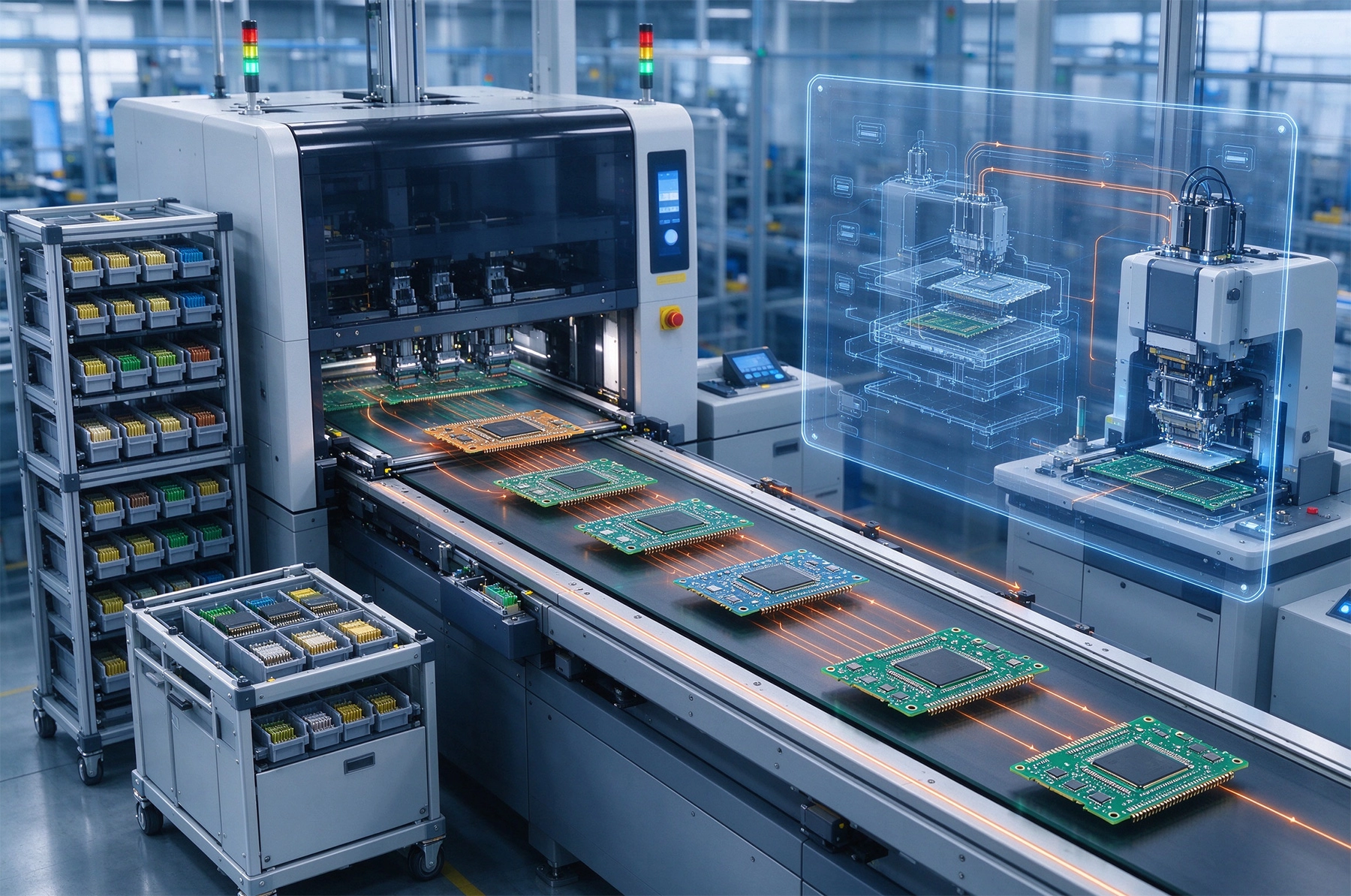
Industrial Electronics — the control systems, power supplies, sensors, and communication modules that run factories, grids, and infrastructure — faces a distinctive set of supply chain pressures that consumer electronics manufacturers do not share to the same degree.
Product lifecycles are long. An industrial control system may be in production for ten to fifteen years, and the manufacturer is obligated to maintain continuity of supply for the full service life of the installed base. This creates a component sourcing problem that consumer electronics manufacturers never face: the ICs and passives specified on a 2015 BOM may no longer be manufactured in 2026, and finding substitutes requires full requalification. Unlike a smartphone manufacturer that can redesign a product annually, an industrial OEM may be legally and contractually prohibited from changing the Bill of Materials without customer approval.
Volume profiles are irregular. Industrial electronics demand tends to be lumpy — large orders followed by quiet periods, with sudden surges driven by infrastructure projects, regulatory deadlines, or equipment upgrade cycles. This demand pattern makes it difficult to maintain the kind of consistent, high-volume component ordering that gives manufacturers leverage with suppliers. A factory automation OEM ordering 5,000 boards per quarter does not have the same supply chain priority as a smartphone manufacturer ordering 500,000 units per month.
Qualification requirements are strict. Industrial products typically require component and assembly qualification to standards like Ipc Class 3, UL certification, IEC functional safety, or ATEX/IECEx for hazardous environments. These qualifications take months and cost money. A component substitution that would be trivial for a consumer device — swapping one MOSFET for a functionally equivalent alternative — can require a full requalification cycle in an industrial context. This makes supply chain agility inherently harder: the flexibility to substitute is real, but the friction of requalification reduces the practical speed of that flexibility.
Component shortages remain the most common cause of Pcb Assembly delays. The underlying dynamics are structural: semiconductor fabs have high capital costs and long lead times to bring new capacity online, so supply cannot respond quickly to demand signals. When a specific IC goes into allocation — meaning the manufacturer allocates supply to preferred customers and limits others — the industrial OEM who does not have a strong relationship with the distributor or manufacturer may find themselves waiting months for allocation while production is halted.
The 2020–2023 shortage cycle demonstrated that the duration of a component shortage is unpredictable. Some categories of ICs — microcontrollers, power management chips, certain analog devices — experienced shortages that lasted two to three years. Industrial manufacturers who had assumed a stable supply of commodity components learned that even "mature process" chips with decades of production history could become unavailable without warning.
Export controls, tariffs, and trade policy have become significant supply chain risk factors. Restrictions on advanced semiconductor technology exports, evolving tariff schedules between major economies, and the increasing use of trade policy as a geopolitical tool have introduced volatility into component pricing and availability that has no precedent in the pre-2018 supply chain landscape.
For industrial manufacturers who source components manufactured in multiple geographies, the risk is not just about availability but about cost predictability. A component that was cost-effective when sourced from one country may become significantly more expensive — or unavailable — if tariff classifications change. Building Supply Chain Resilience requires understanding where components actually come from, not just who you order them from.
Container shipping delays, port congestion, air freight capacity constraints, and the increasing frequency of extreme weather events that disrupt logistics corridors all affect the Industrial Pcb supply chain. A Pcb Assembly is only as available as its least-available component, and logistics disruptions can turn a normally reliable supply chain into a bottleneck that stalls production just as effectively as a component shortage.
The 2021 Suez Canal blockage and the 2022 Shanghai lockdowns demonstrated that logistics disruptions can cascade rapidly through global supply chains. Industrial manufacturers who had optimized their logistics for cost efficiency — minimizing inventory, relying on air freight only for emergencies — found themselves with no alternatives when the emergency became the baseline condition.
Earthquakes, floods, fires, and power grid failures at component fabrication and Pcb Manufacturing facilities create sudden supply gaps. The 2021 Renesas chip plant fire in Hitachinaka, Japan — which供应 for automotive microcontrollers — disrupted global automotive production for months. Similarly, flooding in Malaysia disrupted passive component production in 2021. These events are not predictable in their specific occurrence, but they are predictable in their category: the question is not whether such events will happen, but whether your supply chain has the depth to absorb them.
The most fundamental Supply Chain Resilience strategy is avoiding single-source dependencies wherever possible. For every critical component on the BOM, the procurement team should identify at least one alternative from a different manufacturer that is electrically, mechanically, and thermally equivalent. These alternatives should be pre-qualified — meaning the engineering team has already verified that the alternative meets the design requirements and the assembly process is compatible — before they are needed in an emergency.
Pre-qualification is the hard part. It takes engineering time to evaluate alternatives, and the qualification process may require running test boards, thermal characterization, and functional verification. But the investment pays for itself the first time a primary component goes into allocation and the pre-qualified alternative allows production to continue without interruption. Manufacturers who defer alternative qualification until the crisis is already underway find themselves paying the cost twice: once in the rush qualification effort, and once in the production delay that results while the qualification is being completed.
The Approved Manufacturer List (AML) is the operational tool for managing multi-source strategy. A well-maintained AML documents every approved alternative for each critical component, the qualification basis for the approval, and any process restrictions (for example, an alternative IC that requires a different reflow profile). The AML should be reviewed and updated quarterly, because component lifecycles change continuously and an alternative that was valid two years ago may no longer be available.
The debate between just-in-time inventory and buffer stock is as old as Supply Chain Management itself, and the right answer is not purely ideological — it depends on the product's value density, demand predictability, and the cost of a stockout. For Industrial Pcb assemblies with long service life requirements, a modest buffer of critical components — typically 8 to 16 weeks of forward demand — is almost always economically rational when the alternative is a production line stoppage costing far more than the carrying cost of the inventory.
Strategic stocking decisions should be made explicitly, based on a risk assessment of each component's supply risk. High-risk components — single-source ICs, components from fabs in geopolitically sensitive regions, components with long lead times — deserve higher buffer levels than commodity components with multiple sources and short lead times. The inventory investment is justified by the avoided cost of production disruption.
For PCB bare boards specifically, maintaining a stocked reserve of standard-format boards — or standard-format cores that can be quickly routed and finished — provides a buffer against fabrication lead time extensions. Many PCB fabricators will offer a "blanking" service where they pre-manufacture standard-format cores in large panels, ready for routing and finishing to specific designs on short notice. This approach reduces the effective lead time for non-standard boards from weeks to days, at a modest premium over standard lead-time pricing.
Some of the most effective supply chain resilience work happens in the design phase, before a single board is built. Designing with supply chain resilience in mind means making deliberate choices about component selection, PCB stackup, and manufacturing approach that reduce the probability and severity of supply disruptions.
Using standard, widely available components instead of specialized or application-specific ICs is the single most powerful design decision for supply chain resilience. A microcontroller with a twelve-year production history and dozens of second-source manufacturers is a fundamentally different supply chain risk than a newly introduced processor with a single source. The performance premium of the latest-generation chip is often modest compared to the supply chain risk it introduces.
Picking PCB stackups and surface finishes that are standard offerings at multiple fabricators — rather than highly customized constructions available from only one or two suppliers — reduces the risk of a fabrication bottleneck. A standard 4-layer or 6-layer board with HASL or ENIG finish can be sourced from dozens of fabricators globally. A highly specialized high-frequency or flex-rigid construction may have only three or four qualified suppliers worldwide, any of whom going offline creates immediate supply risk.
Designing for multiple assembly locations is a more advanced strategy used by large industrial OEMs. If the same BOM and design files can be built at two or three qualified assembly facilities in different geographies, a disruption at one location does not stop production. This requires investment in multi-site qualification and maintaining process documentation that is current across all locations, but the redundancy it provides is valuable for high-volume products with stringent delivery commitments.
Transactional supplier relationships — where you buy components at market price and hope they are available — are the least resilient model in a supply chain disruption. Manufacturers who weathered the 2021–2023 shortage most effectively were those with deep distributor and manufacturer relationships: allocated supply during the shortage, early visibility into allocation decisions, and direct communication channels to the people making allocation decisions.
Building these relationships requires consistent volume and payment discipline — suppliers prioritize customers who are reliable and predictable — but the investment in relationship depth pays dividends in every disruption cycle. The manufacturer who calls their distributor's FAE during an allocation crisis and gets a straight answer about allocation timeline and available alternatives is in a fundamentally better position than the one who submitted a purchase order and is waiting for an email response.
Visibility into supplier inventory and production forecasts is increasingly available through distributor portal tools, API integrations, and collaborative planning programs. Manufacturers who invest in connecting their ERP systems to distributor inventory feeds gain real-time awareness of component availability that allows proactive substitution before a shortage becomes a stockout. This level of supply chain digitization is an operational capability that separates resilient manufacturers from reactive ones.
Many supply chain crises in industrial electronics are predictable — they just arrive slowly enough that companies miss the signals. Component manufacturers publish product change notifications (PCNs) when they discontinue a part, change the fab location, or modify the part's specifications. These notifications typically go out 90 to 180 days before the change takes effect, which is enough time to qualify an alternative if the procurement and engineering teams are paying attention.
A digital Bom Management system that automatically cross-references BOM components against manufacturer discontinuation notices and PCN databases can surface these risks proactively. Manufacturers who have implemented this level of BOM intelligence report that the majority of their supply disruptions are now anticipated rather than reactive — they identify a component risk, initiate qualification of an alternative, and execute the substitution on their own timeline rather than in response to a shortage.
The same digital infrastructure enables lifecycle stage monitoring: tracking whether a component is in new product introduction (NPI), active production, or in the decline phase of its lifecycle. Components in decline — where the manufacturer is actively reducing production as they transition to a newer product — should trigger automatic alerts to procurement and engineering, initiating the qualification process for a successor part before the decline phase turns into a discontinuation notice.
For industrial OEMs who rely on contract manufacturers (CMs) for PCB assembly, the CM's supply chain capabilities are a direct extension of the OEM's resilience posture. A CM with strong supplier relationships, component inventory programs, and digital Bom Management can often absorb supply shocks that would cripple an OEM managing assembly internally.
The most valuable CM capability is component procurement leverage. A CM with high volume across multiple customers can aggregate demand and maintain inventory buffers that would be uneconomical for a single OEM. They also have relationships with component distributors that give them earlier visibility into allocation decisions and better allocation priority during shortages.
When evaluating a CM for Industrial Pcb assembly, the supply chain dimension should be a primary evaluation criterion alongside quality and cost. Ask about their component procurement organization, their inventory programs for long-lifecycle products, their BOM management systems, and their track record during the 2021–2023 shortage — specifically, what percentage of their customers' production was disrupted versus those who maintained supply through alternative sourcing. The answers reveal the depth of supply chain capability that is actually available when conditions get difficult.
Supply chain disruptions are not going away. The structural forces that produced the 2021–2023 shortage — growing demand for electronics across every industrial sector, concentrated fabrication capacity, and the inherent inflexibility of just-in-time supply models — have not changed. If anything, the increasing complexity of industrial electronics and the ongoing geopolitical tensions around semiconductor technology will produce more frequent and more varied disruptions in the years ahead.
The manufacturers who navigate these disruptions successfully are not the ones who hope for a stable supply environment. They are the ones who build their supply chains to be inherently flexible: pre-qualifying alternatives before they are needed, maintaining buffer stocks for the highest-risk components, investing in digital visibility tools that surface risks early, and building supplier relationships deep enough to get honest answers when conditions deteriorate. These investments are not free, but they are almost always cheaper than the alternative — a production line stoppage at an industrial facility where every day of delay has direct revenue consequences.
Contact us to discuss your requirements.

Innovative Industrial PCB Solutions for Renewable Energy SystemsAugust/10/2026

Thermal Resistance and Dielectric Layers in Metal Core PCB SolutionsOctober/12/2026
Tailored Industrial PCB Solutions for Medical Device ManufacturersJune/12/2026

How to Find the Right Partner for Your Custom Industrial PCB SolutionsJuly/24/2026

Overcoming Bend Radius Challenges in Flex PCB SolutionsAugust/14/2026

Design Guidelines for Durable Flex PCB Solutions in Dynamic ApplicationsJuly/10/2026

Heavy Copper PCBs: The Solution for High-Current Industrial ApplicationsJune/18/2026
Controlling Impedance in High-Frequency Industrial PCB DesignsJuly/30/2026