Open Nav


The laminate material you select for your PCB defines the electrical performance, thermal behavior, mechanical reliability, and ultimately the field success of your product more than any other single design decision. Three names dominate the Industrial Pcb materials landscape worldwide: Isola, Panasonic, and Shengyi. Each brings decades of formulation expertise, extensive product portfolios, and distinct strengths that make them preferred choices for different application domains. Understanding how these brands compare—where they overlap, where they diverge, and what each does best—helps engineers and procurement professionals make material selections that optimize both performance and cost for their specific requirements. This comparison examines the three brands across the dimensions that matter most in real-world Pcb Design and manufacturing.
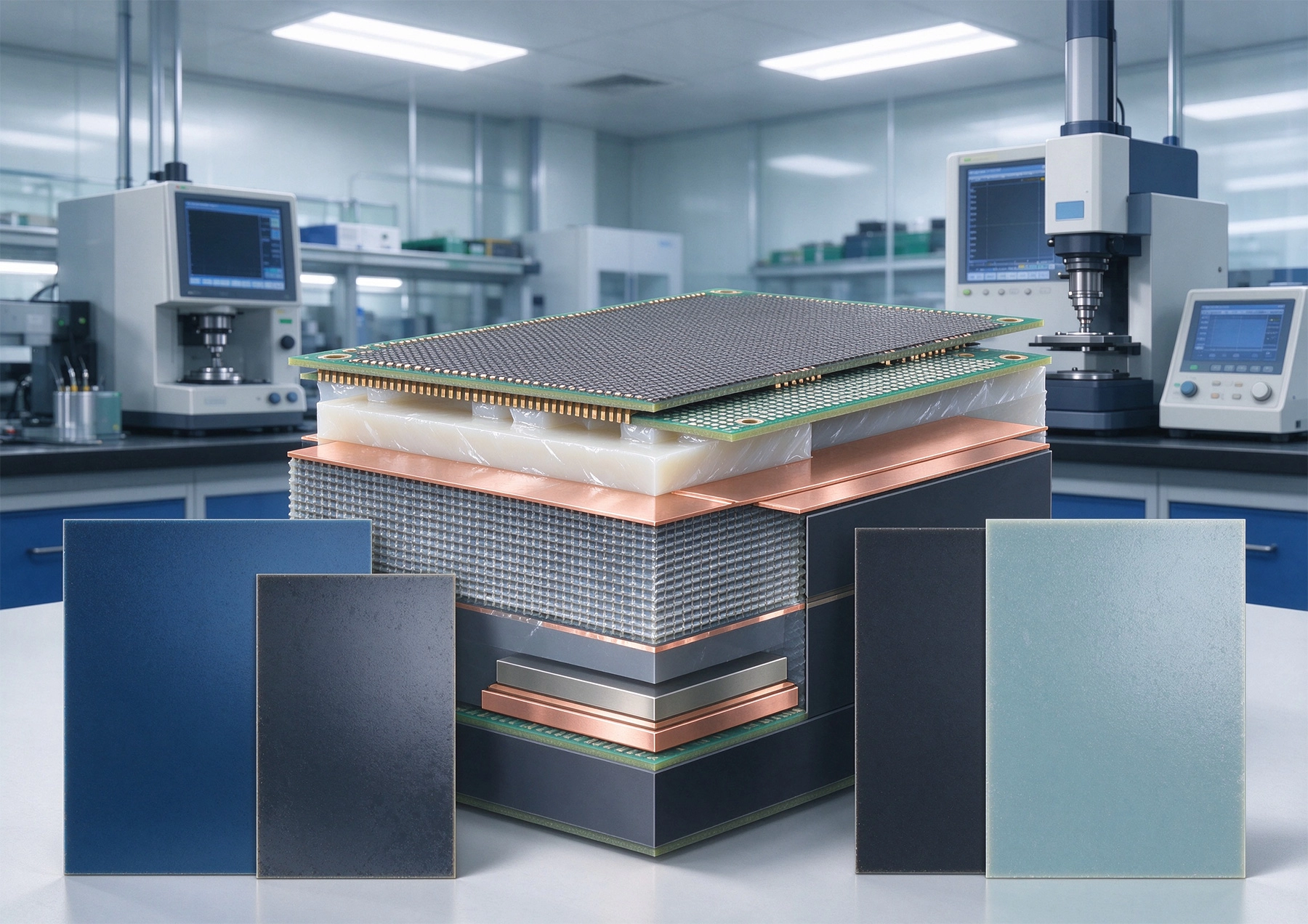
Isola Group has established itself as the benchmark high-performance laminate brand in North America and Europe, with a heritage stretching back over a century in advanced composite materials. The company operates manufacturing facilities in the United States, Germany, and Asia, producing laminates and prepregs that serve the full spectrum of PCB applications from standard FR-4 equivalents to cutting-edge low-loss materials for the highest-speed digital designs.
Isola's product portfolio is organized into families that target specific performance tiers. The FR-4 product line, including materials such as IS410 and IS420, provides reliable performance for standard digital and mixed-signal designs at competitive pricing. Moving up the performance ladder, the 370HR material has become something of an industry standard for applications requiring improved thermal reliability, with a Glass Transition Temperature of 170 degrees Celsius and a decomposition temperature above 350 degrees Celsius that make it suitable for lead-free assembly processes and applications with demanding Thermal Cycling requirements.
For high-speed digital applications where Signal Integrity depends on controlled dielectric properties, Isola offers materials in the I-Tera and TerraGreen families. I-TeraM and I-TeraMT deliver stable Dielectric Constant and low dissipation factor at frequencies well into the gigahertz range, supporting designs operating at data rates that push the limits of conventional FR-4 materials. These low-loss materials are formulated to maintain consistent electrical properties across frequency, temperature, and humidity, providing the predictability that high-speed design simulation requires.
Isola differentiates itself through comprehensive material characterization data that supports accurate Signal Integrity simulation. Their datasheets provide frequency-dependent Dielectric Constant and loss tangent values, thermal mechanical analysis data, and reliability test results that give designers the information they need to model stackup performance with confidence. This commitment to characterization data has made Isola materials the default choice for many Western OEMs designing high-speed boards where simulation accuracy directly impacts design success.
Panasonic's Pcb Materials division, operating under the brand name Panasonic Industry, brings the precision engineering philosophy that characterizes Japanese manufacturing to the laminate industry. With decades of formulation expertise and a vertically integrated manufacturing approach that controls the entire production process from raw resin to finished laminate, Panasonic has earned a reputation for exceptional consistency and lot-to-lot uniformity that matters in volume production where process variation creates yield risk.
The company's product range spans from general-purpose FR-4 materials such as R-1755 to the widely adopted Megtron family of high-performance laminates. Megtron 6 has become one of the most specified mid-range high-speed materials globally, offering a dielectric constant of approximately 3.4 and a dissipation factor around 0.006 at one gigahertz—performance that comfortably supports signaling rates through several gigabits per second at a price point well below the ultra-low-loss tier. This positioning has made Megtron 6 a practical upgrade from standard FR-4 for designs that need better signal integrity without the cost premium of the highest-performance materials.
Megtron 7 represents Panasonic's entry in the ultra-low-loss category, targeting the most demanding high-speed applications including 112G and 224G SerDes channels, backplane interconnects, and the kind of long-reach high-speed links found in data center networking equipment. With dissipation factor values significantly below 0.004 at relevant frequencies, Megtron 7 competes directly with the highest-performance materials from any manufacturer and is specified by major networking and computing OEMs for designs where Insertion Loss budgets leave no room for compromise.
Panasonic was an early leader in halogen-free laminate development, recognizing before many competitors that environmental regulations and customer sustainability requirements would drive demand for materials free of brominated and chlorinated flame retardants. Their halogen-free product lines maintain the flame retardancy needed for safety compliance while eliminating the environmental and health concerns associated with traditional halogenated formulations. This early commitment has given Panasonic a strong position in markets where environmental compliance is a purchasing criterion, including European automotive and consumer electronics.
Shengyi Technology has grown from a domestic Chinese laminate producer to one of the world's largest Pcb Materials manufacturers by volume, a position achieved through aggressive capacity expansion, continuous formulation improvement, and pricing that consistently undercuts Western and Japanese competitors for equivalent performance grades. Shengyi's dominance in the Chinese domestic Pcb Manufacturing market—where the majority of the world's boards are produced—gives them economies of scale and logistical advantages that translate into both cost leadership and supply reliability for Asian-sourced boards.
The company's product range has expanded dramatically over the past decade and now covers the full performance spectrum from standard FR-4 equivalents through mid-loss and low-loss materials suitable for increasingly demanding applications. The S1000 series serves as Shengyi's workhorse FR-4 family, providing reliable performance for the vast majority of standard digital designs at pricing that makes it the default choice for cost-driven manufacturing in China. For applications requiring improved thermal performance, the S1000-2M variant offers a higher Glass Transition Temperature and improved thermal decomposition characteristics that support lead-free assembly and thermally demanding applications.
Shengyi's mid-range and high-performance offerings, including materials in the Si series, target applications that need better electrical properties than standard FR-4 can deliver. While these products historically trailed the performance of Isola and Panasonic equivalents, the gap has narrowed substantially as Shengyi has invested in formulation expertise and manufacturing technology. Current generation Shengyi low-loss materials offer dielectric constant and dissipation factor specifications that support high-speed designs through data rates that would have required Western or Japanese materials just a few years ago.
The practical advantage of Shengyi for many projects is availability and cost within the Chinese manufacturing ecosystem. When your boards are fabricated in China—and most are—specifying Shengyi materials often means shorter lead times, lower material costs, and fewer logistics complications compared to importing Isola or Panasonic laminates for the same board. For applications where the performance of Shengyi's current generation materials is sufficient, this supply chain advantage can be decisive.
The dielectric constant and dissipation factor of a laminate material directly determine the impedance of traces, the propagation velocity of signals, and the Insertion Loss that accumulates along transmission lines. For high-speed designs, these parameters are the primary selection criteria, and the three brands offer different performance-cost tradeoffs at each tier.
At the standard FR-4 level, all three manufacturers offer materials with dielectric constants around 4.2 to 4.5 and dissipation factors in the 0.015 to 0.020 range at one gigahertz. Performance differences at this level are modest, and selection is typically driven by cost and availability rather than electrical properties. Moving to the mid-range, the comparison becomes more interesting. Isola 370HR offers improved thermal performance with moderate loss reduction. Panasonic Megtron 6 provides a meaningful step down in dissipation factor to roughly 0.006, and Shengyi's mid-loss materials target similar performance at lower cost. At the ultra-low-loss tier, Isola I-TeraMT and Panasonic Megtron 7 set the performance benchmark with dissipation factors below 0.004, while Shengyi's latest low-loss offerings approach but have not quite matched this level of performance.
Designers should note that datasheet dissipation factor values measured at one gigahertz may not represent material behavior at the operating frequencies of their specific application. Loss tangent typically increases with frequency, and the rate of increase varies between materials and between brands. Isola and Panasonic provide more comprehensive frequency-dependent characterization data than Shengyi, which is an advantage for designers who need to model insertion loss accurately at frequencies above five gigahertz.
Thermal performance encompasses several material properties that affect both the manufacturability and the field reliability of the finished PCB. Glass transition temperature, decomposition temperature, and coefficient of thermal expansion all influence whether a board can survive lead-free assembly temperatures without Delamination, whether it will maintain reliability through Thermal Cycling in the field, and whether plated through-holes will crack under repeated temperature excursions.
Isola 370HR has established itself as a de facto standard for thermally demanding applications, with a Tg of 170 degrees Celsius and a Td exceeding 350 degrees Celsius that provide substantial margin above the peak temperatures encountered in lead-free reflow profiles. Panasonic's High-tg Materials offer competitive thermal ratings, and their consistency in achieving stated Tg values across production lots is well regarded. Shengyi's thermal-enhanced materials have improved significantly, with current generation products achieving Tg values and decomposition temperatures that support lead-free assembly, though historical reputation for thermal performance variability lingers behind the reality of their current product capability.
The z-axis coefficient of thermal expansion is particularly important for boards with high layer counts and fine-pitch through-hole components, because CTE mismatch between the copper barrel of a via and the surrounding substrate drives fatigue cracking during thermal cycling. Materials with lower z-axis CTE produce more reliable via structures, and this is an area where the higher-performance formulations from all three brands show clear advantage over standard FR-4 compositions.
Material availability varies significantly depending on where your boards are manufactured. Isola maintains stock in North America and Europe that supports relatively short lead times for Western fabricators, but boards manufactured in China may face longer material lead times if Isola laminate must be imported. Panasonic maintains a strong presence in the Japanese and broader Asian markets, with regional distribution that supports reasonable availability for Asian fabricators. Shengyi, as the dominant domestic supplier in China, offers the shortest lead times and best availability for boards fabricated in Chinese facilities.
During periods of supply chain disruption—such as the semiconductor and materials shortages experienced in recent years—domestic availability becomes a significant practical concern. Manufacturers who stock materials regionally can continue production when international logistics are disrupted, while those who depend on imported materials may face extended lead times or allocation constraints. Diversifying material specifications to include qualified alternatives from multiple brands provides Supply Chain Resilience that protects production continuity when a preferred material becomes temporarily unavailable.
Cost differences between the brands are meaningful and consistent across performance tiers. For equivalent performance grades, Shengyi typically offers the lowest price, followed by Panasonic, with Isola commanding the highest price in most markets. These differentials reflect not just material cost but also the overhead structures, geographic logistics, and market positioning of each manufacturer. For cost-driven products where any of the three brands can meet the technical requirements, Shengyi's pricing advantage often determines the selection, particularly for boards manufactured in China.
The optimal Material Selection depends on the interaction of your technical requirements, manufacturing location, volume, and cost constraints. There is no universally best choice—each brand excels in contexts that play to its particular strengths.
For high-speed digital designs in North America or Europe where simulation accuracy and comprehensive characterization data are critical, Isola materials are often the natural first choice. Their datasheets, application support, and regional availability align well with the needs of Western OEMs designing boards that will be fabricated domestically or in nearby facilities. When a design pushes into the ultra-high-speed regime where insertion loss budgets are measured in fractions of a decibel per inch, Isola's I-Tera family or Panasonic's Megtron 7 provide the performance margin that may not be available from current generation Shengyi products.
For designs fabricated in Asia that require performance above standard FR-4 but do not demand the absolute lowest loss available, Panasonic Megtron 6 and Shengyi's mid-loss materials offer excellent price-performance ratios. The choice between them often comes down to the specific performance margin needed, the designer's familiarity with the material's characterization data, and the fabricator's recommendation based on their experience processing each material.
For standard and thermally enhanced applications where the priority is cost efficiency with reliable performance, Shengyi materials offer compelling value, especially when boards are manufactured in China. The performance of their current generation products is adequate for the vast majority of digital designs, and the cost savings combined with supply chain simplicity make them the practical choice for cost-driven production.
Is Shengyi material quality comparable to Isola and Panasonic for standard FR-4 applications?
For standard digital designs operating at moderate speeds, current generation Shengyi FR-4 materials provide performance comparable to equivalent grades from Isola and Panasonic. The primary differences are in characterization data depth and consistency tracking, where Western and Japanese manufacturers maintain an advantage.
Which brand offers the lowest dissipation factor for ultra-high-speed designs?
Panasonic Megtron 7 and Isola I-TeraMT currently offer the lowest dissipation factor values among the three brands, with both materials specified for the most demanding high-speed applications. The choice between them typically depends on fabricator experience and regional availability.
Can I specify different materials from different brands for different layers in a mixed stackup?
Mixed-dielectric stackups using materials from different manufacturers are possible but require careful consideration of Cte Matching, bonding compatibility, and the fabricator's experience with the specific material combination. Consult your fabricator before specifying a mixed stackup across brands.
How do I qualify an alternative material brand when my design currently specifies one brand?
Material qualification typically involves building and testing prototype boards with the alternative material, comparing impedance and insertion loss measurements against the baseline, and verifying that reliability test results meet your requirements. Your fabricator can guide the qualification process based on their experience with both materials.
Do all three brands offer halogen-free options?
Yes, all three manufacturers now offer halogen-free laminate products. Panasonic was the early leader in this category, but Isola and Shengyi have both developed competitive halogen-free formulations that meet the same flame retardancy and performance requirements.
Contact us to discuss your requirements and learn how our experience with Isola, Panasonic, and Shengyi materials helps you select the optimal laminate for your PCB application.
Copper Weight Matters: Optimizing Industrial PCB Materials for Power ElectronicsSeptember/23/2026
The Rise of Halogen-Free Industrial PCB Materials: Benefits and Trade-offsAugust/06/2026
Understanding CTE and Its Impact on Industrial PCB Materials SelectionJuly/18/2026
A Comprehensive Guide to High-Tg Materials for Industrial PCBsJune/05/2026
How to Select Industrial PCB Materials for High-Voltage ApplicationsSeptember/07/2026
FR-4 vs. Polyimide: Choosing the Right Industrial PCB MaterialsJuly/02/2026
A Comprehensive Guide to High-Tg Materials for Industrial PCBsMay/27/2026
Design Rules for Heavy Copper Traces in Power ElectronicsJuly/27/2026