

Choosing the wrong PCB base material can quietly sabotage an otherwise solid design. Your board might work perfectly on the bench, then fail prematurely in the field due to Thermal Cycling, moisture exposure, or vibration. The culprit is often not the circuit design itself—it's the substrate material choice that nobody questioned during development.
FR-4 and polyimide dominate Pcb Material Selection for industrial applications. Both are fiberglass-based dielectrics, but they behave very differently under stress. Understanding these differences isn't optional if you're building products that need to survive demanding environments. This guide cuts through the technical specifications to give you practical guidance for Material Selection.
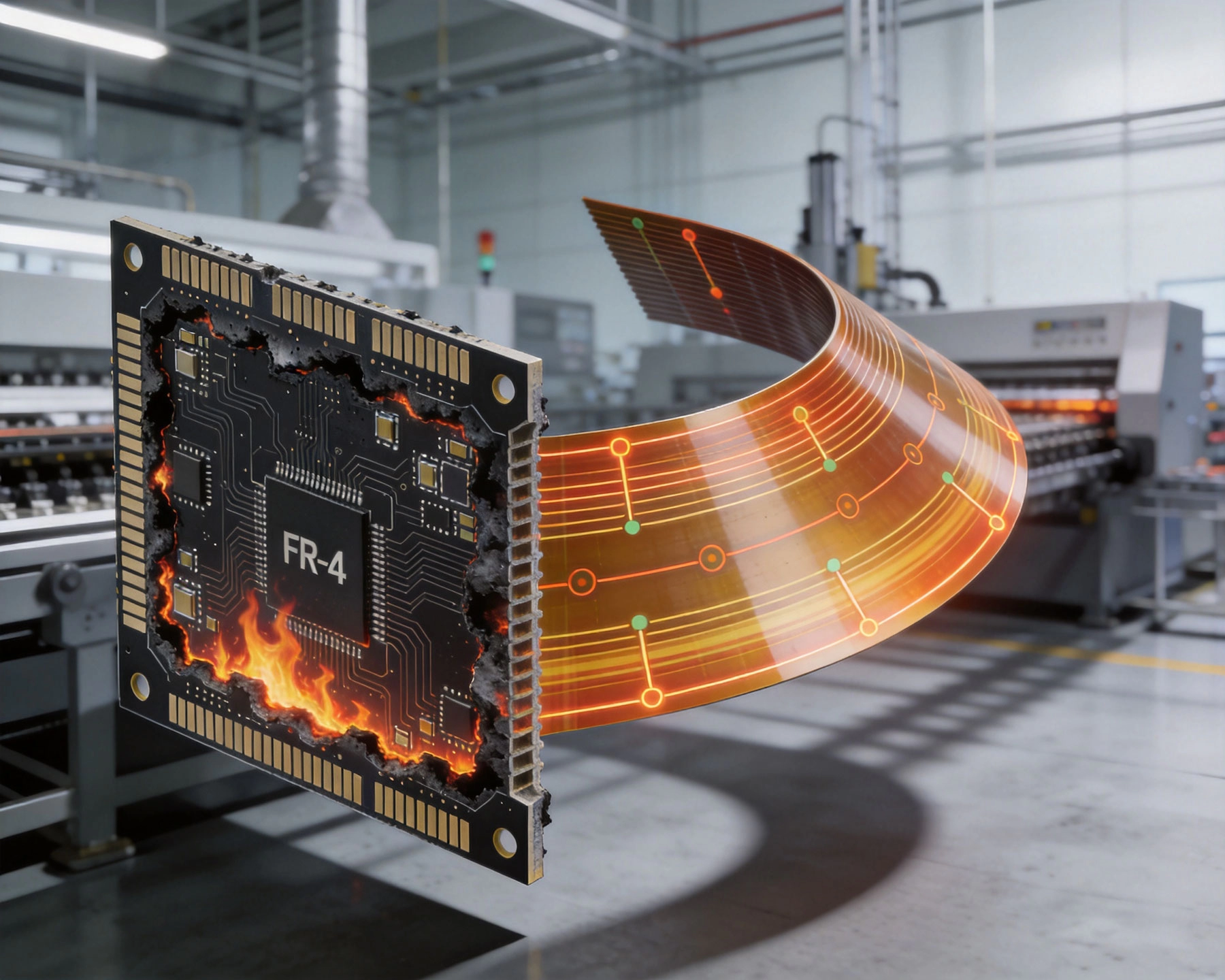
FR-4 isn't a specific material—it's a specification. The NEMA standard defines FR-4 as a glass-reinforced epoxy laminate with specific fire-retardant properties. What this means in practice: woven fiberglass fabric impregnated with epoxy resin, cured under heat and pressure into sheets. The epoxy provides the dielectric properties; the fiberglass provides Mechanical Strength and dimensional stability.
The "FR" stands for Flame Retardant, which is critical for safety certification in most applications. FR-4 passes the UL94 V-0 burn test, meaning it won't sustain a flame and self-extinguishes when the ignition source is removed. This matters enormously for commercial and industrial products that need safety approval.
Within the FR-4 designation, there's significant variation. Standard FR-4 has a Glass Transition Temperature (Tg) around 130-140°C. Mid-Tg variants hit 150°C, and High-tg Fr-4 can reach 170°C or higher. These temperature ratings matter more than most designers initially appreciate.
The Glass Transition Temperature (Tg) is the point where the epoxy resin softens from a rigid state to a rubbery, pliable state. Below Tg, the material maintains its mechanical properties and dimensional stability. Above Tg, the board becomes noticeably more flexible and dimensions shift unpredictably.
For most consumer and commercial applications, FR-4's Tg is perfectly adequate. The highest temperatures components see during assembly (reflow soldering at 245°C peak) are brief and don't typically exceed Tg in well-designed boards. But for industrial environments with sustained high temperatures or significant Thermal Cycling, operating near Tg causes reliability problems that don't show up during testing but emerge during field use.
Standard FR-4 absorbs moisture, typically 0.10-0.15% by weight under normal conditions. This seems small, but it matters for several reasons. Moisture expands significantly when heated (the popcorn effect), which can crack components and delaminate layers during soldering. For boards that will see humid environments or thermal cycling, this is a genuine concern.
Most FR-4 variants require baking before assembly if they've absorbed moisture—typically 2-4 hours at 120°C to drive off absorbed water before reflow. Skip this step with a humid board and you're looking at assembly defects or latent failures.
Polyimide (often called Kapton after DuPont's brand, though many manufacturers produce polyimide materials) is a completely different chemical family. Instead of epoxy, polyimide uses imide chemistry that creates a fundamentally more thermally stable polymer. The result is a material that handles heat far better than any FR-4 variant.
Standard polyimide has a Tg above 250°C, with some formulations exceeding 300°C. More importantly, polyimide doesn't just soften at high temperatures—it maintains useful mechanical properties well above 200°C continuously. For applications involving sustained high temperatures, this isn't optional—it's essential.
The flexural strength of polyimide also exceeds FR-4, meaning polyimide boards handle vibration and mechanical stress better. This is why polyimide appears in aerospace, military, and automotive under-hood applications where survival conditions are extreme.
Polyimide handles thermal cycling dramatically better than FR-4. The coefficient of thermal expansion (CTE) for polyimide is closer to copper's CTE than FR-4 is, which means the board and copper traces expand and contract together more harmoniously during temperature changes. Less CTE mismatch means fewer cracked joints and delaminated traces over thermal cycling.
In testing, polyimide survives 2-3x more thermal cycles than equivalent FR-4 before developing cracks. For products that see daily power cycling or wide temperature swings, this translates directly to field reliability.
Polyimide is available in both rigid and flexible forms, and the flexible variants have revolutionized product design in ways that rigid boards can't match. Flexible polyimide circuits can fold, bend around corners, and fit into spaces where rigid boards simply won't work. Wearables, medical probes, and automotive dashboards all benefit from flexible polyimide circuits.
Even rigid polyimide boards tend to be more flexible than equivalent FR-4, which matters for some applications. If your board will see vibration or mechanical shock, polyimide's greater flexural strength and fatigue resistance provides real advantages.
FR-4 maxes out around 170°C even in high-Tg variants, and performance degrades long before reaching that temperature. Polyimide operates continuously above 200°C and handles brief excursions to 300°C+ without damage. If your application involves sustained high temperatures, polyimide is the only practical choice—there's no version of FR-4 that handles these conditions reliably.
For Lead-free Soldering assembly, both materials handle the thermal profile, but polyimide handles it with less stress due to its higher thermal margin. High-tg Fr-4 is adequate for lead-free; polyimide is overkill unless other factors justify it.
At low frequencies, both materials perform similarly. The Dielectric Constant (Dk) for standard FR-4 is around 4.5, while polyimide is around 4.3—close enough to not matter for most designs. Loss tangent (tan δ), which determines signal losses at high frequencies, is slightly better for polyimide, but the difference is minor below 10 GHz.
For high frequency RF applications, there are better material options than either FR-4 or standard polyimide (high-frequency laminates like Rogers material). Between just FR-4 and polyimide, electrical performance differences don't drive the decision—thermal and mechanical requirements do.
Polyimide resists more chemicals than FR-4, including many solvents, acids, and bases that attack epoxy. This matters for boards in harsh chemical environments or that require cleaning with aggressive solvents. FR-4 is generally adequate for most manufacturing and cleaning processes, but specific chemical exposures may favor polyimide.
Polyimide's superior flexural strength and fatigue resistance make it the clear winner for applications with vibration, shock, or mechanical stress. Military and aerospace applications consistently specify polyimide for boards that must survive extreme environments. FR-4 handles normal handling and moderate vibration fine; beyond that, polyimide's mechanical advantages matter.
Here's where FR-4 dominates for most applications. Standard FR-4 is inexpensive, widely available, and has enormous manufacturing capacity. Polyimide costs 3-8x more per panel depending on the specific grade and thickness. This cost premium is justified for applications requiring polyimide's properties, but it's pure unnecessary expense for boards that FR-4 handles fine.
High-Tg FR-4 sits between standard FR-4 and polyimide in both cost and performance—a reasonable compromise for applications that need more thermal margin than standard FR-4 provides without polyimide's full expense.
FR-4 boards are commodity products available from hundreds of manufacturers within days. Polyimide requires more specialized processing and fewer shops can handle it well. Lead times for polyimide are typically longer, and you're more dependent on specific suppliers. For prototype or small production runs, this supply chain difference is noticeable.
Standard FR-4 works perfectly for:
If your product operates indoors, doesn't generate significant internal heat, and doesn't face unusual environmental stress, FR-4 is almost certainly the right choice. The cost savings are real, manufacturing is straightforward, and reliability is proven across billions of boards.
Mid-Tg or high-Tg FR-4 is appropriate when:
High-Tg FR-4 hits a sweet spot for many industrial applications—enough thermal performance for demanding conditions without polyimide's expense. If you're unsure whether you need polyimide, high-Tg FR-4 is often the right intermediate choice.
Polyimide is clearly the right choice when:
These are demanding applications, and polyimide's cost premium is genuinely justified in these cases. Don't pay polyimide prices for applications that standard FR-4 handles—the expense is unnecessary and the benefits don't apply.
Work through these questions in order to narrow down your material choice:
What's the maximum continuous operating temperature your board will see? If it's under 130°C, FR-4 is viable. Above 150°C, polyimide is essentially required. Between 130°C and 150°C, high-Tg FR-4 is worth considering.
What thermal cycling does your product see? Daily power cycling in an industrial environment? Occasional thermal excursions? Multiple thermal cycles per day? The more thermal cycling, the more polyimide's advantages matter.
Is your product exposed to significant vibration or mechanical shock? FR-4 handles normal handling; military/aerospace vibration levels push toward polyimide.
What's your production volume? High-volume products benefit more from FR-4's cost advantage. Low-volume prototypes can absorb polyimide's premium more easily.
Are there regulatory requirements? Some safety certifications specify material types. Check UL, MIL-SPEC, and any industry-specific requirements before selecting materials.
Lead-free Soldering uses higher peak temperatures (260°C vs 235°C for tin-lead) and longer time above liquidus. Standard FR-4 with Tg around 130°C is marginal for lead-free and can delaminate or measly degrade. Specify high-Tg FR-4 minimum for lead-free products. Most professional PCB shops won't even offer standard Tg for lead-free assembly.
Designers sometimes look at component Tj (junction temperature) ratings without considering board-level temperatures. A component running at Tj of 150°C might only heat the board beneath it to 80°C—but in an enclosed product with poor ventilation, that same component can push board temperature to 120°C or higher. Model actual thermal conditions, not just component specifications.
It's tempting to spec polyimide "just to be safe," but this adds real cost without benefit in many designs. If FR-4 handles your requirements, use it. Polyimide's cost premium is justified by thermal performance or flexibility—not by vague concerns about reliability. Run the analysis, specify FR-4 when it's adequate, and save the polyimide expense for applications that genuinely need it.
Not all PCB manufacturers handle polyimide well. The material requires different processing parameters, and not every shop has optimized their workflow. Before specifying polyimide, confirm your manufacturer has experience with it and can deliver the quality you need. Standard FR-4 is available everywhere; polyimide quality varies significantly between suppliers.
Material Selection between FR-4 and polyimide comes down to matching material properties to application requirements:
The right choice is the one that meets your actual requirements without unnecessary expense. Specify FR-4 when it's adequate. Specify high-Tg FR-4 for demanding commercial applications. Specify polyimide only when your application genuinely requires its unique properties. The cost difference is too substantial to justify otherwise.
Yes, some manufacturers offer hybrid constructions that combine FR-4 cores with polyimide prepreg layers. This can provide some thermal performance benefits while controlling cost. However, the thermal expansion mismatch between materials creates inherent stress in the stack, so this approach requires careful engineering and manufacturer coordination. It's not a common solution, but it exists for specific applications.
No. Polyimide excels in thermal and mechanical performance but costs significantly more and is more challenging to manufacture consistently. For applications where FR-4 is adequate, polyimide provides no benefit despite its premium. Electrical performance is similar at most frequencies. The "better" material is always the one that meets your actual requirements—polyimide isn't universally superior, just better for specific demanding applications.
Ceramic-filled polyimide combines polyimide resin with ceramic particles to improve Dielectric Constant stability and reduce CTE. It maintains polyimide's thermal advantages while providing better dimensional stability and lower moisture absorption. Ceramic-filled polyimide is used in demanding RF and microwave applications where standard polyimide's properties aren't quite sufficient. It costs more than standard polyimide but provides better performance for specialized applications.
Specify by Tg value and thermal performance requirements rather than just "FR-4." Indicate minimum Tg (like "Tg minimum 150°C"), any thermal cycling requirements, and whether lead-free assembly is required. This gives your manufacturer clear targets and reduces the chance of receiving material that doesn't meet your actual needs. Material datasheets should be requested and reviewed for critical applications.
Polyimide generally has better shelf life and moisture resistance than FR-4. Standard FR-4 boards can absorb moisture that affects assembly, requiring baking before use if storage conditions were humid. Polyimide absorbs less moisture and handles storage better. For assemblies stored before use or shipped to humid environments, this is a practical advantage.
Copper Weight Matters: Optimizing Industrial PCB Materials for Power ElectronicsSeptember/23/2026
Understanding CTE and Its Impact on Industrial PCB Materials SelectionJuly/18/2026
The Rise of Halogen-Free Industrial PCB Materials: Benefits and Trade-offsAugust/06/2026
A Comprehensive Guide to High-Tg Materials for Industrial PCBsJune/05/2026
A Comprehensive Guide to High-Tg Materials for Industrial PCBsMay/27/2026
How to Select Industrial PCB Materials for High-Voltage ApplicationsSeptember/07/2026
Advanced Techniques in Multi-Layer Industrial PCB FabricationJune/03/2026
Ensuring Industrial PCB Reliability in Extreme Environmental ConditionsMay/27/2026