Open Nav


Industrial electronic products face operating conditions that consumer devices never encounter. Factory automation controllers mounted near welding robots experience extreme temperatures and electromagnetic interference. Mining equipment operates in environments filled with dust and vibration. Railway signaling systems endure decades of continuous operation through seasons of blistering heat and freezing cold. These demanding applications require manufacturing processes that deliver demonstrated reliability rather than merely theoretical specifications.
Environmental Stress Screening (ESS) provides that proof. By applying accelerated stress conditions to PCBs before they reach customers, manufacturers identify and eliminate latent defects that would otherwise cause premature field failures. ESS doesn't improve product design—it validates that manufacturing processes consistently produce boards capable of surviving intended service conditions.
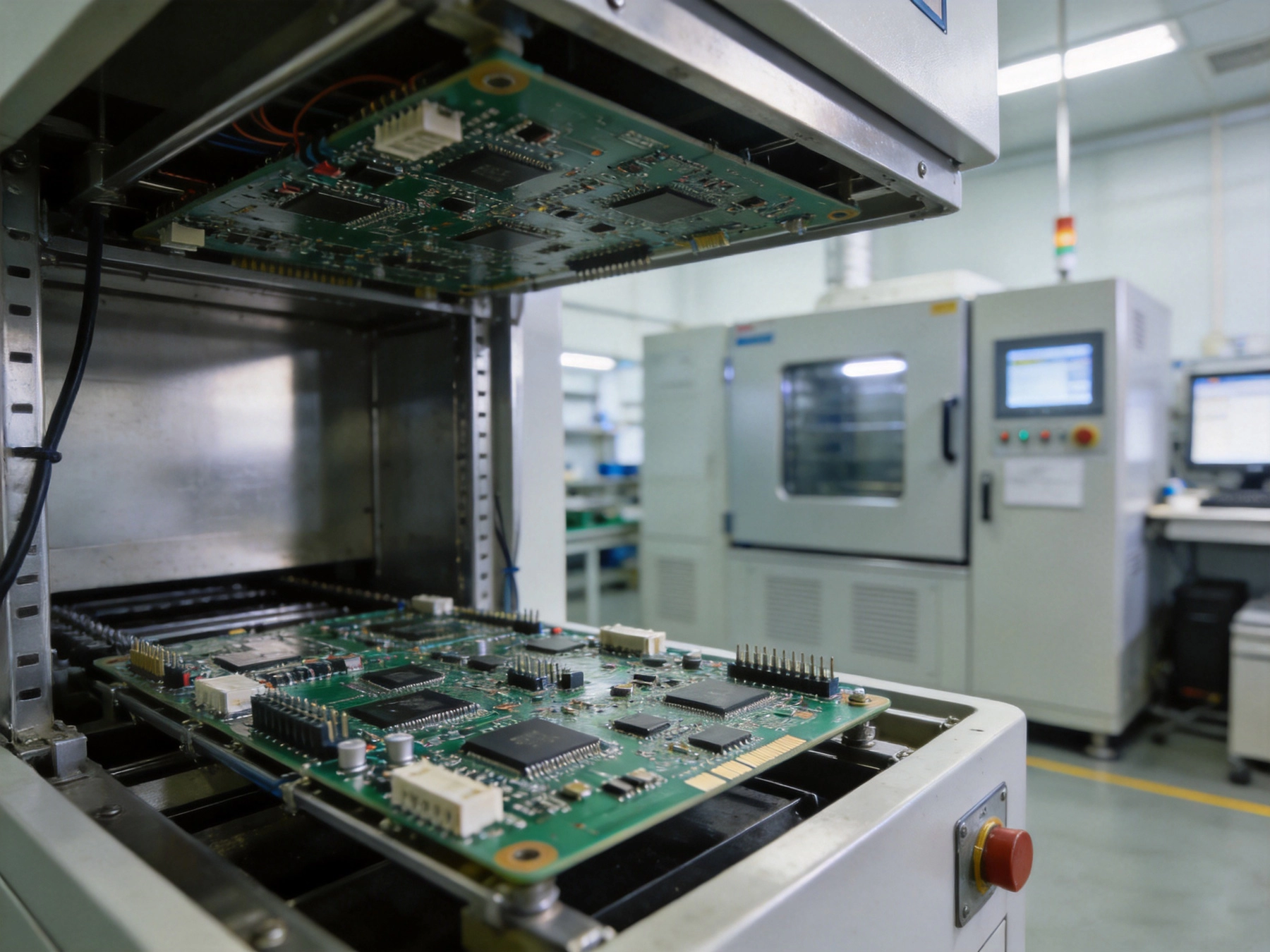
ESS subjects products to stress levels exceeding normal operating conditions but below design limits. This acceleration compresses time, revealing defects that would manifest only after months or years of field service. The philosophy assumes that manufacturing defects follow predictable patterns when stressed beyond their tolerance margins, while properly manufactured products survive within their design margins.
This approach differs fundamentally from burn-in testing. Burn-in applies stress over extended durations at stress levels closer to operating conditions. ESS typically uses higher stress levels for shorter durations, targeting defects with lower activation energy that manifest quickly under aggressive acceleration.
Field failures carry costs that extend far beyond replacement part expenses. Industrial equipment downtime disrupts operations, potentially costing thousands of dollars per hour in lost production. Field service calls require technician travel, diagnostic time, and potential replacement inventory. Warranty claims accumulate administrative overhead while potentially signaling quality problems to customers.
ESS adds manufacturing cost through test equipment, facilities, and processing time. However, these expenses typically represent a fraction of field failure costs. For high-reliability applications where failure consequences are severe, ESS often achieves return on investment exceeding 10:1 through avoided warranty claims, service calls, and reputation damage.
ESS effectively exposes manufacturing defects including marginal solder joints with insufficient wetting, components with hidden damage from handling or storage, contamination that creates leakage paths under humidity exposure, and Plating Defects that will eventually corrode. These defects share a common characteristic—they pass normal Functional Testing but fail when stress reveals their inadequate margins.
Design defects remain hidden through ESS because the stress levels deliberately stay below design limits. If a board fails ESS, that failure indicates either excessive stress application or manufacturing process variation—not necessarily a design problem. Distinguishing these causes requires investigation that separate ESS findings from design validation.
Temperature cycling stresses materials with different coefficients of thermal expansion. Solder joints, component bodies, laminate substrates, and copper traces all expand and contract at different rates during Thermal Cycling. These differential movements accumulate fatigue damage in marginal connections until cracks propagate completely through joints.
Industrial ESS thermal cycles typically span -40°C to +85°C or wider ranges depending on application requirements. Cycle rates vary from slow (30 minutes per cycle) to fast (5 minutes per cycle), with faster cycles creating higher thermal gradients that stress different failure mechanisms. Multiple thermal cycle profiles may be applied sequentially to screen for different defect types.
Vibration screening applies acceleration energy that stresses mechanical connections throughout the assembly. Manufacturing defects like cold solder joints, loose components, and inadequate staking fail when vibration energy overcomes their marginal mechanical integrity. Random vibration spectra better represent real-world vibration than discrete frequency sweeps.
ESS vibration levels typically range from 5g to 20g RMS depending on application severity. Duration spans minutes to hours, compressed from years of field exposure. Mounting configuration during vibration must match production installation to ensure stress distribution represents actual service conditions.
Many defects manifest only under combined stress conditions. Temperature-humidity screening exposes boards to elevated temperature and humidity simultaneously, accelerating Electrochemical Migration that would require months to appear at ambient conditions. Combined thermal-vibration profiles stress boards in ways that single-stress screens cannot replicate.
Sequential stress profiles apply different stress types in succession—perhaps Thermal Cycling followed by random vibration. This approach exposes different defect categories while allowing diagnostic isolation of failure mechanisms. However, sequential screening extends processing time and may mask failures that combined stress would reveal.
HASS represents an aggressive evolution of traditional ESS. Rather than applying stress levels with known relationships to field failure rates, HASS pushes stress to levels approaching design limits, searching for any defect that manifests. The goal is defect discovery rate rather than correlation with field reliability predictions.
HASS requires careful validation to ensure that stress levels don't exceed design margins, which would cause good products to fail. This technique works best for mature products where design margins are well characterized and manufacturing process variations are understood.
Industrial ESS demands test chambers capable of maintaining tight temperature uniformity across the product volume. Thermal chambers must achieve specified ramp rates while maintaining temperature accuracy within ±2°C or tighter. Vibration shakers require adequate force capacity to accelerate products of the expected mass, with control systems that maintain specified acceleration spectra.
Data acquisition systems record temperature, vibration, and product functional status throughout screening. This documentation proves that stress application met specifications and identifies when products failed during screening. Traceability between screening records and product serial numbers enables Failure Analysis and process improvement.
ESS profile development balances acceleration effectiveness against risk of overstressing good products. Initial profiles often derive from industry standards like MIL-STD-810 for military applications or IPC-9592 for commercial electronics. These baselines require validation and adjustment based on actual product characteristics and manufacturing process capabilities.
Prototype screening during development identifies stress levels that cause failures in known defective units versus good units. This characterization establishes stress margins that production screening can exploit. Profiles that pass all units without revealing defects indicate insufficient acceleration; profiles that cause good units to fail require stress reduction.
ESS typically occurs after Functional Testing but before final inspection and packaging. This positioning catches manufacturing defects before shipment while avoiding stress exposure for products that fail functional test. However, some defect categories benefit from stress before functional test, where stress exposure reveals defects that functional test would catch anyway.
Throughput planning must account for ESS duration when calculating production capacity. Thermal chambers and vibration shakers represent capacity constraints that batch processing can address but not eliminate. Buffer inventory between screening and subsequent operations provides scheduling flexibility without extending delivery lead times.
ESS effectiveness measures through defect detection rates—typically expressed as percentage of known defective units that fail screening. High detection rates approaching 90-95% indicate effective screening; lower rates suggest stress levels insufficient to reveal defects or screening duration too short for defect activation.
False positive rates measure screening failures in units that would have performed reliably in service. These rates indicate risk of over-stress or overly sensitive defect detection. Balancing detection rate against false positive rate optimizes screening parameters for specific product and market requirements.
ESS investment decisions benefit from formal cost-benefit analysis. Calculate ESS cost per unit including equipment depreciation, operating expenses, floor space, and labor. Compare against estimated field failure costs including replacement parts, service labor, travel, equipment downtime, and customer relationship impact. The ratio determines whether ESS achieves positive return for your specific situation.
Sensitivity analysis explores how ESS effectiveness assumptions affect results. If ESS reduces field failures by 50% versus 30%, does the investment still make sense? Understanding this range guides decisions when exact parameters are uncertain.
ESS generates valuable data beyond defect detection. Failure Analysis of screening escapes—units that pass screening but fail in the field—identifies defect types that screening doesn't effectively expose. This information drives process improvements that address root causes rather than relying solely on screening to catch defects after manufacture.
Trend analysis of screening results tracks manufacturing process stability. Increasing failure rates signal process drift requiring investigation. Decreasing rates may indicate process improvements or, concerningly, screening effectiveness declining as defect patterns shift beyond screening detection capability.
Industrial applications typically demand more rigorous ESS than consumer products. Longer expected service life—15 to 20 years for industrial equipment versus 3 to 5 years for consumer devices—creates greater exposure to latent defect manifestation. Consequences of field failure often include equipment damage or production disruption, not merely customer inconvenience.
Industry-specific standards guide ESS implementation for various sectors. Railway applications reference EN 50155, Industrial Automation follows IEC 61000 specifications, and aerospace applications reference DO-160 environmental conditions. Understanding which standards apply to your products ensures compliance while avoiding unnecessary screening for non-applicable requirements.
Custom industrial PCBs often serve applications with unique environmental challenges that generic ESS profiles cannot address adequately. Servo drive controllers mounted near motor starters experience electromagnetic interference combined with thermal stress. Precision instrumentation requires screening profiles that preserve calibration accuracy through stress exposure. Harsh environment sensors need screening that verifies sealing integrity remains intact.
Application-specific ESS development addresses these unique requirements. Characterizing the specific environmental stresses that products will experience—through measurement campaigns, customer requirements analysis, or standards review—enables targeted screening that provides genuine reliability assurance rather than generic compliance theater.
ESS screens manufacturing defects, not design inadequacies. A board with insufficient thermal margin or marginal component derating will pass ESS if manufacturing produces it correctly—but will fail in service when operating conditions exceed design assumptions. Design validation requires different testing approaches that stress products at or beyond specification limits.
ESS cannot eliminate all field failures. Some failure mechanisms have activation energies too high for practical acceleration. Others depend on rare random events like cosmic radiation or manufacturing variations too subtle for screening detection. ESS reduces field failure rates significantly but cannot guarantee zero failures.
Excessive stress exposure causes wear-out mechanisms to begin during screening, effectively consuming part of product life. Boards that pass ESS but approach wear-out limits may fail sooner than expected in service. This phenomenon, called negative acceleration, contradicts the assumption that screening always improves reliability.
Monitoring field failure rates relative to screening parameters reveals whether over-screening is occurring. If field failures increase despite increased screening, stress levels or durations may be excessive. Careful correlation between screening parameters and field performance optimizes ESS without causing additional failures.
Industrial customers increasingly require ESS documentation as part of supplier quality packages. Reports should include stress specification and achieved values, product identification and quantities screened, screening profile with temperature and vibration data, functional test results before and after screening, and failure analysis for any products that didn't complete screening successfully.
Documentation format should support customer review and audit. Electronic records with digital signatures provide traceability and prevent unauthorized modification. Archival procedures must maintain records for periods matching product service life expectations—typically 15 to 20 years for industrial equipment.
Various industry sectors mandate ESS or equivalent screening for safety-critical applications. Medical device regulations require design validation and process validation that may include environmental stress testing. Automotive safety systems fall under functional safety standards that mandate failure prevention measures.
Compliance mapping documents how ESS implementation satisfies specific regulatory or customer requirements. This mapping proves that screening serves defined purposes rather than representing arbitrary process overhead. When customers or auditors request justification for ESS practices, documented compliance mapping provides the required evidence.
Not every product requires ESS. Assess your specific situation: What are the field failure consequences? What reliability levels do customers expect? What reliability history suggests failure likelihood? What industry standards or customer requirements mandate screening? The answers to these questions determine whether ESS investment makes sense for your product portfolio.
Products with history of field failures, safety-critical applications, long service life requirements, or harsh environmental exposure typically justify ESS investment. Products with short expected service life, low failure consequences, and mature manufacturing processes may not benefit from screening cost.
New ESS programs benefit from phased implementation. Begin with products most likely to benefit—high-reliability applications with documented field failure history. Use initial screening results to refine profiles before expanding to broader product ranges. This approach builds organizational competence while managing implementation risk.
Consider external screening services during initial implementation. Contract laboratories with established ESS capabilities provide screening without capital equipment investment, enabling experience building before committing to permanent facilities. This approach also provides benchmark comparisons that validate internal screening effectiveness.
ESS applies higher stress levels for shorter durations to accelerate defect activation. Burn-in uses lower stress levels closer to operating conditions over extended durations. ESS targets quick-to-manifest defects through aggressive acceleration; burn-in targets defects requiring longer exposure time to activate.
ESS duration varies based on product complexity, stress profiles, and defect detection objectives. Simple thermal cycling profiles may complete in 2-4 hours per unit. Comprehensive combined-stress profiles may require 24-48 hours. High-reliability aerospace screening sometimes extends to 80-160 hours per unit.
Properly designed ESS exposes products to stress levels below design limits, avoiding damage to correctly manufactured units. However, screening does consume some product life through wear mechanisms. Monitoring field failure rates helps identify whether screening parameters risk negative acceleration effects.
ESS costs vary widely based on product size, screening complexity, and production volume. Small PCB screening may cost $5-15 per unit in external laboratories. Large industrial assemblies with extensive thermal and vibration screening may exceed $100 per unit. High-volume internal screening can reduce costs to $1-5 per unit after capital equipment investment.
Profile validation typically involves screening prototype units with known defects versus known good units. Defective units should fail screening; good units should pass. Iterative adjustment of stress levels and durations optimizes detection rates while maintaining acceptable false positive rates.
Failed products undergo failure analysis to determine defect type and root cause. If defects trace to manufacturing processes, corrective actions address those processes. Products cannot be reworked and rescreened for all defect categories—some failures indicate systemic problems requiring process changes rather than individual product rework.
Environmental Stress Screening provides manufacturing process validation that functional testing alone cannot achieve. By revealing latent defects before products reach customers, ESS reduces field failures, protects product reputation, and prevents the costly consequences of industrial equipment downtime. For applications where reliability determines safety outcomes or business success, ESS represents a strategic investment rather than mere quality overhead.
Implementing ESS effectively requires understanding your specific products, their application environments, and your manufacturing process characteristics. Generic screening profiles provide starting points, but optimization for your unique situation extracts maximum benefit while avoiding over-screening costs. Continuous Improvement through ESS data analysis drives process enhancements that reduce defect generation rather than relying solely on screening to catch defects after manufacture.
The decision to implement ESS ultimately connects to your business strategy. Products where reliability differentiation drives competitive advantage justify investment in comprehensive screening programs. Products competing primarily on cost may find that ESS overhead undermines price competitiveness. Understanding where your products sit on this spectrum guides ESS investment decisions that align with business objectives.
Identifying and Fixing Micro-Vias Issues in Industrial PCB Quality InspectionsSeptember/10/2026

Understanding IPC Class 3 Standards for High-Reliability Industrial PCBsJune/11/2026
Why Electrical Testing is Non-Negotiable for Industrial PCB QualitySeptember/29/2026
The Role of Flying Probe Testing in Industrial PCB Quality ControlJuly/22/2026
The Impact of Surface Roughness on High-Speed Signal IntegrityOctober/13/2026
Essential Quality Control Tests for Industrial PCBs- ICT, FCT, and AOIMay/27/2026
How to Implement a Robust Quality Assurance Plan for Industrial PCBsJuly/07/2026
The Engineer's Checklist for Industrial PCB DFM Before Sending to FabSeptember/24/2026