Open Nav


Connectors are one of the most common failure points in electronic devices, responsible for up to 35% of all electronic system failures according to industry reliability studies. In applications exposed to vibration, shock, temperature extremes, or moisture, connector failure rates rise even higher, often leading to premature device failure, costly downtime, and expensive warranty repairs. For decades, product designers have had to accept connectors as a necessary evil for interconnecting multiple circuit boards within a device. Today, Flex Pcb (flexible printed circuit board) solutions eliminate this tradeoff entirely, enabling connector-free designs that significantly improve device reliability while reducing size, weight, and assembly complexity.
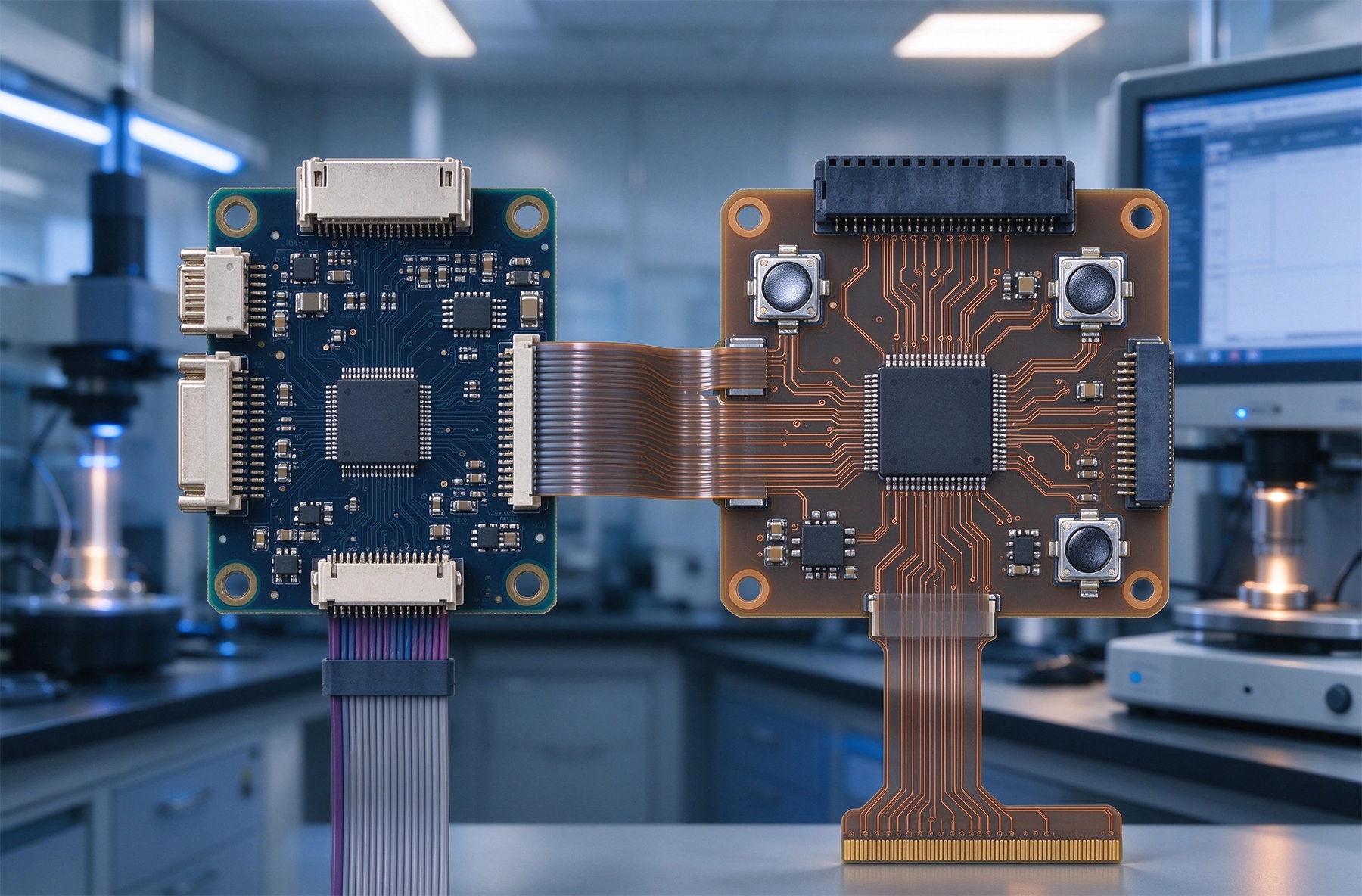
Connectors introduce multiple points of potential failure into any electronic design:
For applications requiring the highest levels of reliability, such as medical devices, aerospace systems, Automotive Electronics, and industrial equipment, these connector-related risks are unacceptable. Flex Pcb solutions eliminate these risks entirely by replacing multiple rigid PCBs and their connecting cables and connectors with a single integrated flexible circuit.
Flex PCBs are made from thin, flexible polymer substrates that can be bent, folded, and shaped to fit complex three-dimensional spaces. This unique property enables designers to eliminate connectors in two primary ways:
Instead of designing a product with multiple rigid PCBs connected by cables and connectors, you can design a single flex PCB that integrates all circuit elements into one continuous circuit. The flexible sections of the circuit act as the "interconnects" between different functional areas, eliminating the need for separate connectors entirely. All electrical connections are part of the same copper circuit, with no physical contact points to fail.
For designs that require the rigidity of traditional PCBs in certain areas (for component mounting or structural support), rigid-flex PCBs combine rigid PCB sections with flexible interconnect sections in a single integrated board. The rigid sections provide stable mounting for components, while the flexible sections connect the rigid sections without the need for connectors. Rigid-flex designs offer the best of both worlds: the component mounting stability of rigid PCBs and the interconnect reliability of flex circuits.
In both cases, all electrical connections are etched directly into the circuit during manufacturing, eliminating the need for separate connectors, cables, or wiring harnesses. This reduces the total number of components in a design by 20-50% in most cases, with a corresponding reduction in potential failure points.
Eliminating connectors with flex PCB solutions delivers significant reliability improvements:
Each connector in a design introduces dozens of potential failure points (one for each contact pin, plus the mechanical housing and locking mechanism). Eliminating connectors removes all these failure points entirely, reducing overall system failure risk by 30-60% depending on the number of connectors replaced. For example, a design that previously used three connectors with 20 pins each eliminates 60 potential contact failure points by switching to a flex PCB solution.
Flex PCBs have excellent vibration and shock resistance, as there are no loose connectors or cables to work loose under mechanical stress. The integrated construction of flex circuits ensures all connections remain secure even under extreme vibration and shock loads, making them ideal for automotive, aerospace, and industrial applications that are exposed to constant mechanical stress. Testing shows that flex PCB designs can withstand 10-20 times higher vibration levels than connector-based designs without failure.
Connector-free flex designs eliminate the gaps and crevices present in connector interfaces, where moisture, dust, and corrosive materials can accumulate. Flex circuits can also be coated with protective conformal coatings or encapsulated to provide additional protection against harsh environmental conditions, making them suitable for use in high-humidity, high-corrosion, or dust-prone environments where connectors would quickly degrade.
Eliminating connectors removes the impedance discontinuities and signal reflections introduced by connector interfaces, resulting in significantly better Signal Integrity, especially for high-speed or high-frequency signals. Flex PCBs also support Controlled Impedance routing and consistent signal paths, making them ideal for high-performance applications such as 5G communications, high-speed data transmission, and RF systems. The consistent electrical properties of integrated flex circuits also reduce electromagnetic interference (EMI) and crosstalk between signal paths.
Connectors are a leading source of assembly errors, as they require precise alignment and proper seating during manufacturing. Eliminating connectors removes these assembly steps entirely, reducing the risk of human error during production and improving overall manufacturing yield. Flex circuits are manufactured as a single unit, requiring far fewer assembly steps than multi-board connector-based designs, which reduces production variability and improves consistent quality.
Flex PCB designs have significantly longer service life than connector-based designs, especially in harsh operating environments. With no contact points to wear out or corrode, flex circuits can deliver reliable performance for decades, even with repeated flexing and exposure to extreme conditions. This makes them ideal for applications requiring long service life with minimal maintenance, such as medical implants, satellite systems, and industrial control equipment.
Flex PCB solutions are particularly beneficial in applications where reliability is critical:
To maximize the reliability benefits of connector-free flex PCB designs, follow these best practices:
Connectors have long been a necessary but unreliable component in electronic designs, responsible for a significant share of all electronic system failures. Flex PCB solutions eliminate this critical reliability liability by replacing multiple rigid boards, cables, and connectors with a single integrated flexible circuit. The resulting connector-free designs deliver dramatic improvements in reliability, vibration resistance, environmental durability, and signal integrity, while also reducing size, weight, and assembly complexity. Whether you're designing automotive electronics, aerospace systems, medical devices, or compact consumer products, eliminating connectors with flex PCB solutions is one of the most effective ways to improve overall system reliability and reduce long-term failure risks.
Contact us to discuss your requirements.
A: Eliminating connectors typically reduces overall system failure risk by 30-60%, depending on the number of connectors replaced and the operating environment. In high-vibration applications, reliability improvements can be even greater.
A: While flex PCBs have higher upfront manufacturing costs than rigid PCBs, the total cost of ownership is often lower when you factor in reduced assembly costs, lower failure rates, reduced warranty costs, and elimination of connector and cable expenses.
A: Flex PCBs can eliminate internal connectors between circuit boards within a device. For external connectors that allow user connection of accessories or cables, flex PCBs can be used to connect the external connector to the main circuit, improving reliability of the internal connection.
A: Static flex PCBs (not bent after installation) can last for decades with proper design and protection. Dynamic flex PCBs designed for repeated bending can withstand 10,000 to 1,000,000+ bend cycles depending on materials and design.
A: Yes, high-temperature flex Pcb Materials are available that can operate continuously at temperatures up to 200°C or higher, making them suitable for under-hood automotive, aerospace, and industrial applications.
Signal Integrity Benefits of High-Layer Count and HDI SolutionsAugust/12/2026
An Introduction to HDI Technology for Compact Industrial ElectronicsJune/16/2026
Innovative Industrial PCB Solutions for Renewable Energy SystemsAugust/11/2026
How Heavy Copper Solutions Improve Reliability in Motor DrivesSeptember/16/2026
Stack-up Design Strategies for High-Layer Count Industrial PCBsOctober/09/2026

How to Find the Right Partner for Your Custom Industrial PCB SolutionsJuly/24/2026
Reducing Weight and Space with Rigid-Flex Industrial PCB SolutionsJuly/28/2026
Rogers vs. PTFE: Comparing Materials for High-Frequency SolutionsSeptember/17/2026