Open Nav


Box Build Assembly—also called system integration or Level 3 assembly—is where individual PCB assemblies transform into complete, shippable products. While PCB Fabrication and component mounting represent advanced manufacturing capabilities in their own right, box build introduces an entirely different set of challenges: mechanical integration, Cable Management, sub-system coordination, compliance testing, and the discipline of managing hundreds of parts into a coherent final product.
For Industrial Electronics manufacturers, box build is where the real complexity lives. A beautifully fabricated PCB is only part of the equation. The enclosure must be prepared, sub-assemblies mounted, cables routed and terminated, connectors mated, and the complete system tested against the specifications that matter to the end customer. Getting any of this wrong costs far more than a PCB respin—because the entire system has to be reworked.
This guide covers everything you need to know about industrial Box Build Assembly: what it encompasses, how the process works, the key challenges, and how to manage them effectively.
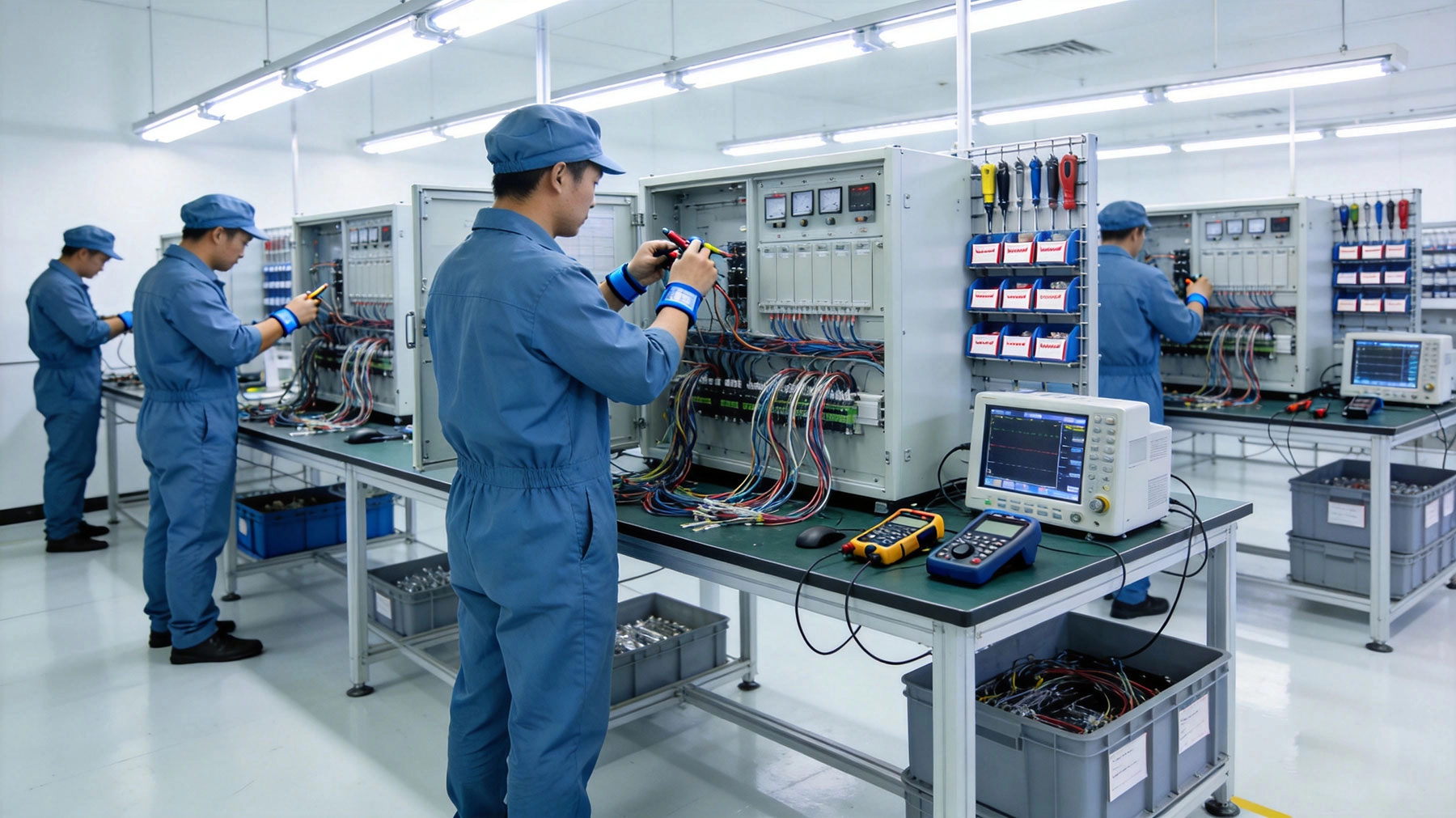
Box build assembly is the process of integrating individual electronic assemblies and components into a complete, functional product housed in its final enclosure. It encompasses everything beyond the bare board: the mechanical structure, cable harnesses, sub-modules, power supplies, displays, switches, indicators, and all the interconnections that make a product complete.
The electronics industry classifies assembly into levels:
Level 0 — Component: Individual electronic components are manufactured and packaged.
Level 1 — Pcb Assembly: Components are mounted onto printed circuit boards (surface mount and through-hole).
Level 2 — Module Assembly: PCB assemblies are combined with other components into functional modules or sub-assemblies.
Level 3 — Box Build / System Integration: Modules, sub-assemblies, cables, and hardware are integrated into the final product in its enclosure.
For industrial equipment—industrial controllers, motor drives, power supplies, communication systems, test and measurement equipment, medical devices, and defense electronics—Level 3 box build represents the majority of manufacturing complexity and cost.
The enclosure is more than a container—it defines the product's environmental protection, Thermal Management, electromagnetic compatibility, and mechanical integrity. Mechanical integration includes mounting PCB assemblies and sub-modules into the chassis, installing hardware (standoffs, fasteners, brackets), and ensuring proper grounding and shielding throughout the mechanical structure.
Industrial products typically contain multiple internal cable harnesses connecting sub-assemblies, Power Distribution, signal routing, and external connections. Cable harness assembly involves wire cutting and stripping, terminal crimping, connector assembly, cable routing and lacing, and protective sleeving or conduit installation. Each harness is often a custom part with significant labor content.
Complex products break into sub-assemblies—power supply modules, display assemblies, input/output panels, communication modules, cooling systems. Each sub-assembly may come from internal production or external suppliers. Managing sub-assembly quality, timing, and integration is one of the most demanding aspects of box build.
Industrial products require switches, knobs, indicators, displays, and labeling that meet both functional and aesthetic requirements. Front panel assembly includes bezel mounting, switch and indicator installation, display integration, and Silkscreen or overlay application. This work is often labor-intensive and requires careful attention to ergonomics and brand presentation.
Bringing all sub-assemblies together into the final enclosure, mating all cable connectors, installing covers and seals, applying torque specifications to fasteners, and performing the mechanical completion that makes the product ready for test.
Before assembly begins, every component and sub-assembly must be verified against the bill of materials (BOM). This includes PCB assemblies from your own production or from suppliers, purchased sub-assemblies and modules, cable harnesses, mechanical hardware, packaging materials, and any specialized components. Incoming inspection catches BOM discrepancies early—before they cascade into assembly errors. Kitting is the process of organizing all components for a specific build quantity into organized kits that travel through the assembly process. Good kitting reduces assembly errors and improves throughput significantly.
The enclosure is prepared before PCBs and sub-assemblies are installed. This includes installing standoffs and threaded inserts, mounting hardware that will be hidden by components, applying thermal interface materials, installing shielding and grounding contacts, and preparing any sealing elements for later closure.
Individual modules and sub-assemblies are installed into the chassis in a logical sequence that ensures access for subsequent steps. Power supply modules are often installed first, followed by the main Pcb Assembly, then peripheral modules, display assemblies, and I/O modules. Each installation requires torque specification compliance, connector mating verification, and mechanical alignment checks.
Cable routing is one of the most technically demanding box build operations. Wires must be routed to avoid hot components, moving parts, and EMI-sensitive signal paths. Cable ties must be applied at specified intervals, and cables must be dressed to look professional and maintain their position throughout the product's service life. Every termination—crimp, solder, or connector mate—must be verified.
Once the system is mechanically complete, it moves to test. Functional Testing verifies that the product operates according to specifications: power-up sequence, communication interfaces, input/output functionality, display and indicator operation, and safety circuit verification. Products may undergo burn-in—extended operation under load—to identify infant mortality failures before shipment.
Industrial products must meet applicable safety and electromagnetic compatibility standards: UL 61010 for test and measurement equipment, CE marking requirements (EN 55032 for EMC, EN 61010 for safety), FCC Part 15 for radiated emissions, and product-specific standards for the target market. Compliance testing may be performed in-house or at accredited third-party laboratories, depending on the product and certification requirements.
Final inspection verifies mechanical completion, appearance, labeling, and documentation. Serial numbers and product identification labels are applied and recorded. Operation manuals, test reports, and certificates of conformance are compiled. The product is packaged for shipment according to its environmental requirements.
A box build product may have a BOM with 200–2000 line items spanning PCB assemblies, purchased modules, cable harnesses, mechanical hardware, fasteners, connectors, labels, and packaging. Any BOM error—wrong part, wrong quantity, superseded part—creates rework. Sophisticated Bom Management systems and rigorous change control are essential for managing this complexity at scale.
Industrial products often have multiple variants—different voltage options, connector configurations, regional requirements, or feature sets. Each variant may require different cable harnesses, and managing variant-specific wiring without error is one of the most common sources of field failures. Manufacturing engineering must design harnesses that are clearly differentiated and build processes that prevent variant mix-ups.
Comprehensive Functional Testing of complex industrial products is time-consuming and expensive. In-circuit Test and flying probe test cover individual PCB assemblies, but system-level functionality—communication protocols, analog performance, power quality—requires specialized test equipment and longer test times. Balancing test coverage against manufacturing cost requires careful analysis of failure modes and their consequences.
When a defect is found after full assembly, rework is exponentially more expensive and time-consuming than catching it earlier. A bad solder joint on a sub-assembly found after box closure requires disassembly. A connector mismatch found after all connectors are mated requires re-terminating. Designing the assembly sequence to catch defects as early as possible, and training technicians in proper rework procedures, is critical to managing rework cost.
Industrial products require documentation that traces every component back to its source: material certifications, test reports, certificates of conformance, CE technical files, and RoHS/REACH compliance declarations. This documentation burden grows with product complexity and can become a significant bottleneck if not managed systematically throughout the manufacturing process.
The same DFM principles that apply to Pcb Design extend to box build. Products that are designed for efficient assembly cost less to build and have fewer defects. Key DFA principles for box build include designing for access (arrange components so that assembly and test can reach everything without disassembly), reducing fastener count (clip connections and snap fits cost less than screws), using modular sub-assemblies that can be tested independently before final integration, and standardizing connections and components across product families.
The order in which sub-assemblies are installed and cables are routed dramatically affects build efficiency and defect rate. A well-optimized build sequence ensures that earlier steps don't create obstacles for later ones, that Test Points remain accessible throughout assembly, and that defects are caught at the earliest possible point. Manufacturing engineering should invest time in optimizing build sequences—it pays back many times over in production.
Industrial products have mechanical requirements that are invisible to electrical test: fastener torque values that ensure grounding and structural integrity, connector mating forces that prevent intermittent connections, sealing torques that maintain IP ratings. These specifications must be documented, communicated, and verified. Using calibrated torque tools and documenting torque values is non-negotiable for quality-conscious manufacturers.
Box build is often more labor-intensive and less automated than PCB assembly. The quality of work instructions directly determines build quality and throughput. Effective work instructions include clear step-by-step assembly sequences, photographs or illustrations at each step, references to torque specifications and other critical parameters, any special handling requirements, and verification points where inspection occurs. Work instructions should be living documents—updated whenever a better method is found.
Box build technicians work with a wider variety of processes than PCB assembly: crimping, wire preparation, connector assembly, mechanical installation, test equipment operation. Each process requires specific training and periodic verification of competency. IPC/WHMA-A-620 certification for cable harness assembly is the industry standard for training cable and wire harness technicians. Investing in technician training pays back in reduced rework and improved quality.
A comprehensive test strategy addresses different failure modes at appropriate stages:
In-circuit Test (Ict): Applied to individual PCB assemblies before box build. Verifies component presence, orientation, and basic electrical connectivity. Catches component-level defects before they are buried in the assembly.
Flying Probe Test: Alternative to Ict for low-to-medium volume production. Less expensive fixture investment but longer test time. Suitable for complex boards where ICT fixtures would be prohibitively expensive.
Functional Test: Applied to the complete or partially complete box build. Verifies system-level functionality: power supplies generate correct voltages, communication interfaces operate, inputs and outputs respond correctly, displays and indicators function. This is the most important test for the end customer's perception of product quality.
Burn-In: Extended operation under load—typically 24 to 72 hours—at elevated temperature. Identifies infant mortality failures (components that fail early in their life) before products ship. Essential for products where field failures are costly or dangerous.
Hi-Pot and Ground Bond Testing: Safety tests that verify insulation integrity and grounding connection. Required for products that connect to line voltage or must meet specific safety standards. These tests must be performed by qualified personnel using calibrated equipment.
EMC Pre-Compliance Testing: Testing performed during development and production to verify that the product meets electromagnetic compatibility requirements before formal compliance testing at an accredited laboratory. Identifying EMC problems early in design and during production is far less expensive than failing formal compliance testing.
Box build supply chains are typically more complex than PCB Fabrication alone because they involve more component categories from more suppliers:
Sub-Assembly Suppliers: Power supplies, displays, cooling modules, and specialized sub-assemblies often come from specialist manufacturers. Supplier quality programs, incoming inspection, and long-term relationship management are essential.
Cable Harness Suppliers: Custom cable harnesses may be produced in-house or outsourced to specialist harness manufacturers. Whether in-house or outsourced, harness production requires dedicated engineering attention to design, process control, and quality verification.
Enclosure and Mechanical Hardware: Sheet metal fabrication, machining, and injection molding suppliers provide enclosures and mechanical components. These suppliers must meet tolerances for fit and finish that directly affect product appearance and function.
Long-Lead and Single-Source Components: Industrial products often contain components with long lead times or single-source dependencies. Supply chain risk management—strategic inventory, qualified alternate sources, and demand visibility—is as important for box build as it is for any other manufacturing operation.
Understanding what drives box build cost helps in making good design and sourcing decisions:
Labor Content: Box build is labor-intensive. Labor cost per unit depends on assembly time (number of steps and time per step), test time (complexity of test procedures), and rework rate (defects requiring repair). Design simplification directly reduces labor content.
Test Equipment Investment: Comprehensive testing requires test equipment investment that scales with product complexity. Products with specialized interfaces, high voltages, or complex analog functions require correspondingly specialized test equipment. Spreading test equipment investment across product families reduces per-unit cost.
Documentation Burden: Traceability documentation, certificates of conformance, and compliance files represent significant administrative cost. Systematic collection of test data and build records throughout production—rather than compiling documentation after the fact—dramatically reduces documentation cost.
Non-Recurring Engineering (NRE): First article inspection, test program development, work instruction creation, and process qualification are amortized across production volume. Products with small annual volumes may have prohibitively high NRE costs on a per-unit basis.
Industrial box build assembly is where Electronics Manufacturing gets real. It requires managing complexity across mechanical, electrical, and process disciplines; coordinating multiple supply chains; implementing rigorous test and inspection procedures; and maintaining documentation that satisfies both internal quality requirements and external regulatory obligations.
The manufacturers who excel at box build are those who approach it as an engineering discipline rather than simple labor. They invest in build sequence optimization, work instruction quality, technician training, and systematic process control. They design products that are optimized for assembly, not just for function. And they maintain the supply chain relationships and inventory strategies that ensure production continuity.
Whether you're building your first industrial product or optimizing an established manufacturing operation, treating box build with the same engineering rigor you apply to Pcb Design and firmware development will pay dividends in quality, cost, and delivery performance.
Industrial PCBA: Navigating the Complexities of Box Build AssemblyJune/09/2026
Manufacturing Processes for Extreme Heavy Copper Industrial PCBsAugust/15/2026
How to Ensure Quality Control in High-Mix Low-Volume Industrial PCBAJuly/21/2026
The Importance of Component Obsolescence Management in Industrial PCBAAugust/07/2026
Selective Soldering Techniques for Mixed-Technology Industrial PCBA<September/09/2026
X-Ray Inspection: Why It's Vital for Complex Industrial PCBA ProjectsSeptember/26/2026
SMT vs. Through-Hole: Best Practices for Industrial PCBAJuly/07/2026
Precision Engineering: Tolerances in High-End Industrial PCB FabricationSeptember/03/2026